
Building a Renewable Energy Future Through Climate Justice and Inclusive Participation
As the climate crisis intensifies and global calls to transition away from fossil fuels grow stronger, Bangladesh faces a critical question: how can the country ensure a just, equitable, and sustainable energy transition that leaves no one behind?
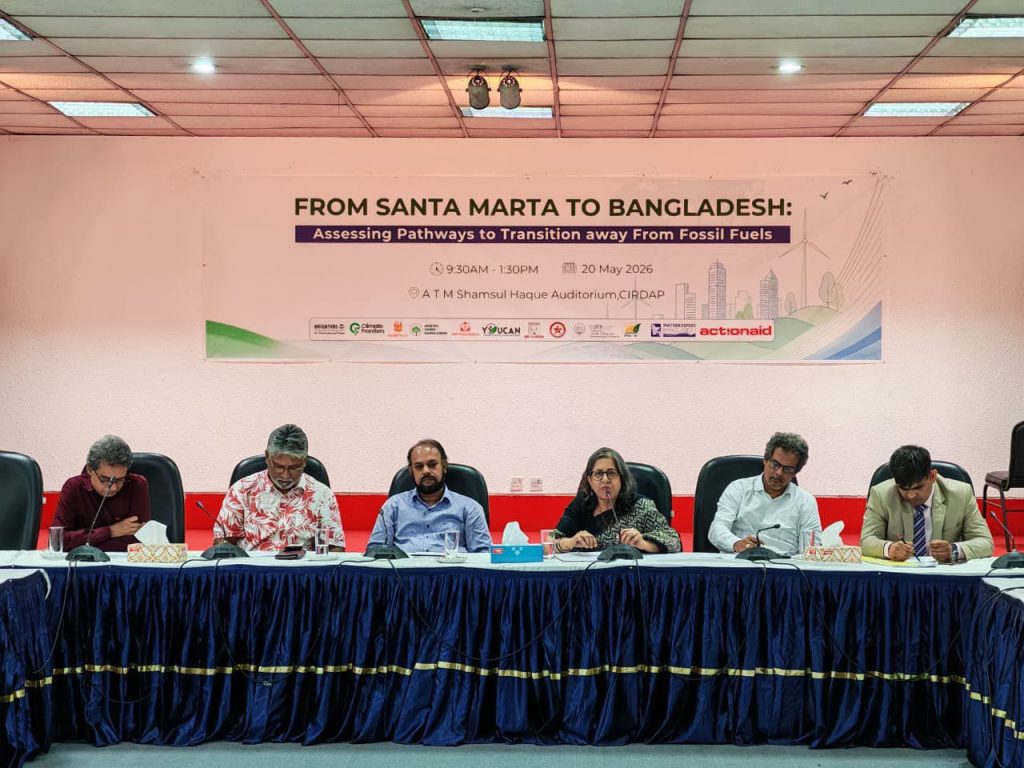
To address this challenge, a significant national dialogue titled “From Santa Marta to Bangladesh: Assessing Pathways to Transitioning Away From Fossil Fuels” was held in Dhaka. The event brought together policymakers, researchers, climate advocates, youth leaders, farmers’ representatives, and civil society organizations to explore pathways toward a people-centered and climate-resilient energy future.
The discussion was jointly organized by Waterkeepers Bangladesh alongside Young Climate Action Network (YOUCAN) and ten like-minded organizations committed to advancing climate justice and sustainable development in Bangladesh.
Why a Just Energy Transition Matters for Bangladesh
Bangladesh is among the countries most vulnerable to climate change, despite contributing minimally to global greenhouse gas emissions. Rising temperatures, extreme weather events, river erosion, floods, and sea-level rise continue to affect millions of people across the country.
At the same time, Bangladesh remains heavily dependent on fossil fuels to meet its growing energy demand. Experts at the dialogue emphasized that continuing to invest in coal, gas, and other fossil fuel infrastructure risks locking the country into an unsustainable development pathway while increasing climate vulnerabilities.
A just energy transition offers an alternative approach by ensuring that the shift toward renewable energy creates economic opportunities, protects livelihoods, promotes social equity, and strengthens climate resilience.
Bringing Diverse Voices to the Table
The session was chaired by Farah Kabir, Country Director of ActionAid Bangladesh, while Md. Ziaul Haque, Additional Director General of the Department of Environment, attended as the Chief Guest.
Distinguished speakers included Sharif Jamil, Coordinator of Waterkeepers Bangladesh; Shafiqul Alam, Lead Analyst at IEEFA Bangladesh; Badrul Alam, President of Bangladesh Krishok Federation; alongside representatives from civil society organizations, youth movements, research institutions, and community groups.
The dialogue highlighted the importance of inclusive decision-making, ensuring that those most affected by climate change and energy policies have a meaningful role in shaping the country’s future.
Key Recommendations for Bangladesh’s Energy Transition
Participants stressed that Bangladesh must urgently develop a practical and inclusive roadmap for transitioning away from fossil fuels while ensuring climate justice and sustainable economic development.
Several key recommendations emerged from the discussion:
1. Increase Investment in Renewable Energy
Speakers called for greater public and private sector investment in renewable energy technologies, including solar and wind power, to reduce dependence on fossil fuels and strengthen energy security.
2. Prioritize Renewable Energy in the National Budget
Dedicated incentives and financial support mechanisms for renewable energy projects should be incorporated into upcoming national budget allocations to accelerate clean energy adoption.
3. Secure Adequate Climate Finance
Developing countries like Bangladesh require increased international climate finance to support mitigation, adaptation, and energy transition efforts while addressing the disproportionate impacts of climate change.
4. Ensure Inclusive Participation
A truly just transition must guarantee meaningful participation of women, youth, workers, farmers, indigenous communities, and local stakeholders in planning and implementation processes.
5. Remove Barriers to Solar Energy
Participants recommended withdrawing taxes and duties imposed on solar energy equipment to make renewable energy technologies more affordable and accessible.
6. Phase Out Coal Expansion
Speakers emphasized the need to halt the expansion of coal-based power generation and redirect investments toward sustainable and renewable energy alternatives.
7. Align National Strategies with COP31 Goals
Bangladesh should adopt renewable energy-centered development strategies ahead of COP31 to strengthen its climate leadership and align with global efforts to limit temperature rise.
The Role of Youth in Shaping the Energy Future
Youth participation emerged as a central theme throughout the dialogue. Young people are increasingly at the forefront of climate advocacy, demanding ambitious action from governments and institutions.
Organizations such as Young Climate Action Network (YOUCAN) continue to create platforms where young leaders can engage with policymakers, contribute to national discussions, and advocate for climate justice and sustainable development.
As future generations will bear the greatest consequences of today’s energy decisions, ensuring youth representation in energy transition planning is not optional; it is essential.
Moving From Dialogue to Action
The national dialogue concluded with a clear message: Bangladesh’s energy future must be built on renewable energy, climate justice, and inclusive governance.
Achieving a just transition requires coordinated action from government institutions, civil society, development partners, the private sector, and local communities. It also requires bold policy decisions that prioritize people and the planet over short-term fossil fuel investments.
With COP31 on the horizon, Bangladesh has a unique opportunity to demonstrate leadership by advancing a people-centered energy transition that supports sustainable development, protects vulnerable communities, and contributes to global climate goals.
The time to act is now. A just and renewable energy future for Bangladesh is not only possible, it is necessary.