
YOUCAN Participates in National Dialogue on Building a Fair and Competitive Low-Carbon Economy
As countries around the world accelerate efforts to address climate change, the concept of a just transition is becoming increasingly important. For Bangladesh, the challenge is not only reducing carbon emissions but also ensuring that workers, businesses, communities, and young people can benefit from the transition to a sustainable economy.
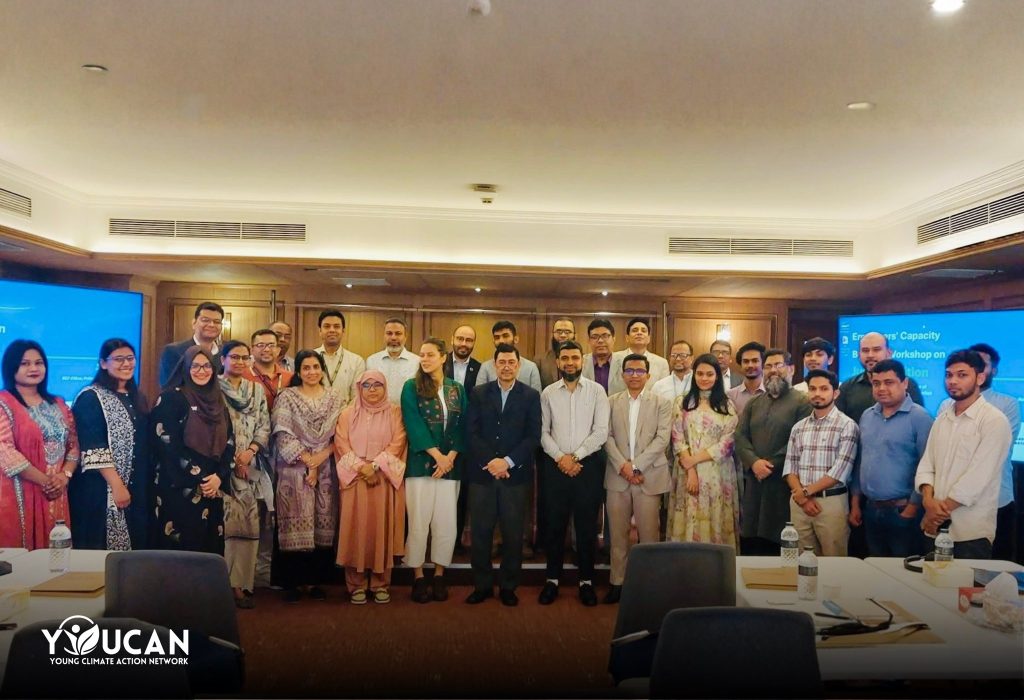
Recognizing the growing importance of this issue, Young Climate Action Network (YOUCAN) participated in the Employers’ Capacity Building Workshop on “Just Transition: Positioning Just Transition as a Driver of Competitiveness, Productivity and Market Access for Enterprises in Bangladesh,” jointly organized by the Bangladesh Employers’ Federation (BEF) and the International Labour Organization (ILO) in Dhaka on 19 May 2026.
Representing YOUCAN, Deputy Executive Director Rashed Jia Rana joined employers, industry representatives, development practitioners, and policy stakeholders to discuss how Bangladesh can navigate the transition toward a low-carbon economy while ensuring economic growth, social inclusion, and decent work opportunities.
Understanding Just Transition in the Bangladeshi Context
The transition away from fossil fuels and carbon-intensive industries is no longer a future possibility. It is already shaping global markets, investment decisions, trade requirements, and business competitiveness.
Countries and industries that fail to adapt to emerging sustainability standards risk losing access to international markets, climate finance opportunities, and green investment flows.
For Bangladesh, a just transition means ensuring that climate action strengthens economic resilience rather than creating new inequalities. It requires balancing environmental responsibility with job creation, skills development, worker protection, and inclusive economic growth.
The workshop provided a valuable platform to explore how businesses can prepare for these changes while maintaining productivity and competitiveness in an increasingly climate-conscious global economy.
Why This Conversation Matters to YOUCAN
For the past two years, YOUCAN has actively worked on issues related to just energy transition, climate justice, youth participation, and renewable energy advocacy.
As discussions on energy transition continue to gain momentum nationally and internationally, YOUCAN sees labour rights, employment opportunities, and economic transformation as essential components of climate action.
The organization recognizes that energy systems, livelihoods, and environmental sustainability are deeply interconnected. Decisions made today about energy, infrastructure, and industrial development will directly influence the future of jobs, economic opportunities, and climate resilience in Bangladesh.
Participation in the workshop reflects YOUCAN’s commitment to engaging in conversations that shape these transitions and ensuring that young people have a voice in determining the future of the economy.
The Link Between Climate Action and Economic Competitiveness
One of the central themes of the workshop was the growing relationship between sustainability and business competitiveness.
Global supply chains are increasingly demanding stronger environmental standards, lower carbon footprints, and greater transparency from producers and exporters.
As a result, businesses that invest in clean technologies, energy efficiency, sustainable production systems, and workforce development are likely to gain stronger market access and long-term competitive advantages.
Participants discussed how just transition strategies can help enterprises remain productive while adapting to changing economic realities and international expectations.
Rather than viewing climate action as a cost, the discussion highlighted how sustainability can become a driver of innovation, investment, and economic opportunity.
Ensuring Youth Perspectives in the Transition
Young people will inherit the long-term consequences of today’s economic and climate decisions. Yet youth perspectives are often underrepresented in discussions on industrial transformation, labour markets, and economic planning.
YOUCAN believes that meaningful youth participation is essential to building transition pathways that are inclusive, equitable, and future-ready.
Young people are not only climate advocates. They are future workers, entrepreneurs, innovators, policymakers, and community leaders who will help shape Bangladesh’s economic transformation.
By participating in national discussions on just transition, youth organizations can help ensure that policies address the needs, aspirations, and opportunities of future generations.
Looking Ahead
Bangladesh stands at an important crossroads. The country must navigate the transition toward a low-carbon future while maintaining economic growth, protecting workers, and strengthening competitiveness in global markets.
Achieving this balance will require collaboration among government institutions, employers, workers’ organizations, civil society, youth groups, and development partners.
The Employers’ Capacity Building Workshop demonstrated that just transition is not only an environmental issue. It is also an economic, social, and developmental priority.
For YOUCAN, participation in this dialogue represents another step in advancing a vision of climate action that is fair, inclusive, and people-centered. As Bangladesh continues its journey toward a sustainable future, ensuring that no one is left behind must remain at the heart of the transition.
A truly just transition is one that creates opportunities, protects livelihoods, strengthens resilience, and builds a greener economy for present and future generations.