
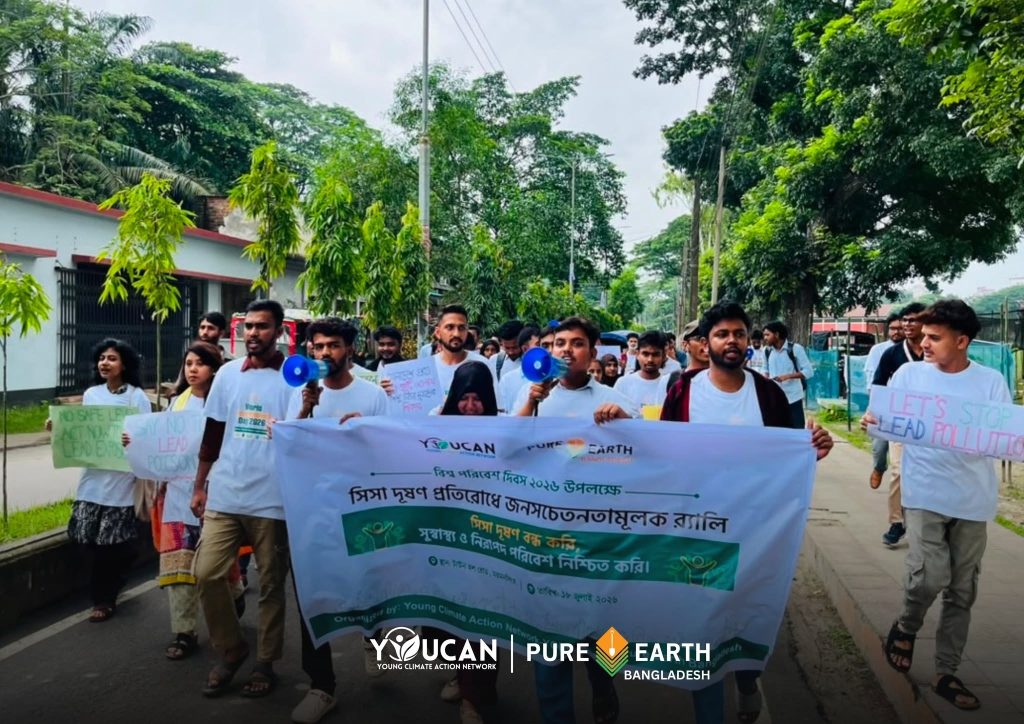
Youth-led rallies in Bangladesh demand action on “invisible” lead pollution crisis affecting millions of children
Youth groups, students, teachers and volunteers took to the streets in Mymensingh and Sylhet on 18 and 19 July, demanding stronger government action against lead pollution, a contaminant researchers say is quietly damaging the health and cognitive development of a huge share of Bangladesh’s children.
The rallies were organized by the Young Climate Action Network (YOUCAN), a youth-led climate advocacy group, with support from Pure Earth Bangladesh, an organization focused on toxic pollution. Marchers carried a single message: “Stop Lead Pollution. Protect Children. Secure the Future.”
The scale of the problem is well documented, even if public awareness of it remains limited. A landmark 2020 analysis by UNICEF and Pure Earth estimated that 35.5 million children in Bangladesh have blood lead levels above the World Health Organization’s threshold of concern, making it the fourth most-affected country in the world by the number of children affected. More recent, nationally representative data has softened that picture somewhat: a 2025 government survey conducted with UNICEF found that 38% of children have elevated blood lead levels, using a 50 µg/L threshold, still more than 20 million children losing IQ points, underperforming in school, and facing higher long-term health risks. Researchers note the exposure is heavily concentrated around Dhaka, where it is roughly twice as widespread as in the rest of the country, and that wealthier families are not protected, children from richer households are in fact more likely to be exposed than poorer ones.
The economic toll is significant too. A 2024 study commissioned through Pure Earth put the combined health burden of lead exposure in Bangladesh at $28.6 billion in a single year, equivalent to 6 to 9% of GDP, with IQ losses alone costing an estimated $16 billion a year in lost lifetime productivity.
Campaigners point to one source above all others. Since Bangladesh banned leaded petrol in 1999, the first country in South Asia to do so, the main driver of urban lead exposure has shifted to informal recycling of used lead-acid batteries, where the regulatory response has not kept pace with the changing sources. More than 1,100 informal battery recycling sites operate around the country, alongside other sources including lead-adulterated turmeric, unsafe gold ash recycling, e-waste, and lead-based paints.
Lead exposure is largely invisible but its effects are permanent, organizers said, reducing children’s learning ability, affecting behaviour, and causing lasting health problems. In Sylhet specifically, organizers said a significant number of children in the division have elevated blood lead levels, a claim consistent with the national picture, though no division-specific figure was cited at the rally.
Campaigners are calling for stronger regulation of lead use and disposal, formal and safe battery recycling systems, routine blood lead monitoring for children, and a nationwide public awareness campaign. Government attention has been building gradually: the Ministry of Environment, Forest and Climate Change and UNICEF held a national workshop on the issue in November 2024, and the Bangladesh Bureau of Statistics has for the first time included blood lead level testing in its Multiple Indicator Cluster Survey, intended to build the national evidence base needed for stronger legislation.
YOUCAN said the Mymensingh and Sylhet rallies were meant to build public pressure for policy change rather than serve as one-off demonstrations, and thanked Pure Earth Bangladesh and the students, volunteers and community members who took part in both cities