
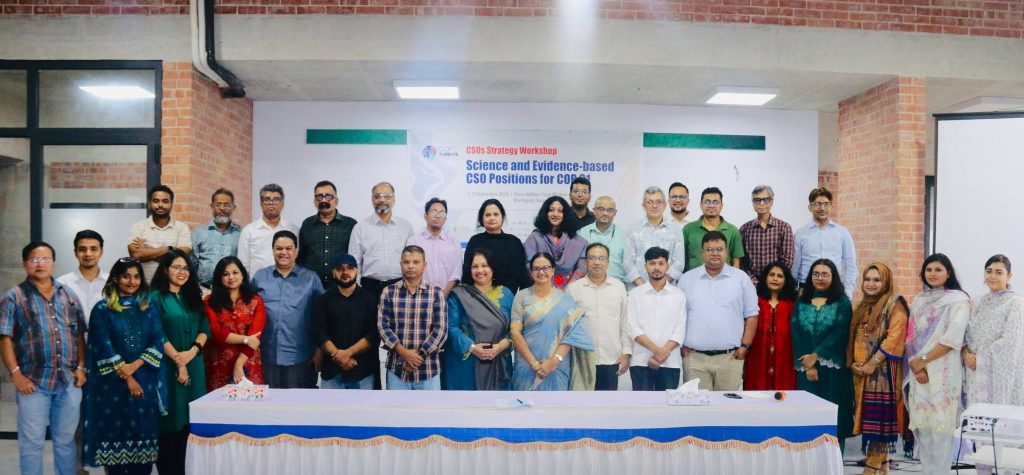
Deputy Executive Director Rashed Jia Rana Joins Civil Society Leaders and Climate Advocates to Advance Evidence-Based Climate Policy and Coordinated Advocacy Ahead of COP31
Young Climate Action Network (YOUCAN) is pleased to share that its Deputy Executive Director, Rashed Jia Rana, participated in the CSO Strategy Workshop Towards COP31: Strategy Workshop on Climate Change Policy Narratives, held from 3–5 September 2026 in Manikganj, Bangladesh. The three-day workshop brought together diverse civil society actors and climate stakeholders to strengthen collective understanding of critical climate policy issues and explore opportunities for coordinated advocacy ahead of the 31st United Nations Climate Change Conference (COP31).
The workshop provided a platform for civil society organisations, youth advocates, researchers, human-rights practitioners, media professionals, and policy advocates to exchange perspectives, identify shared priorities, and discuss how civil society can contribute to shaping climate policy narratives. It emphasised the importance of evidence-based engagement, collaborative action, and inclusive representation in advancing climate justice within national and international climate processes.
Bringing Civil Society Together Ahead of COP31
The workshop was organised by the Center for Participatory Research and Development (CPRD), Climate Justice Alliance Bangladesh (CJA-B), and Climate Action Network South Asia – Bangladesh (CANSA-BD). The initiative aimed to strengthen civil society engagement in climate policy discussions and support the development of informed, coherent, and coordinated positions ahead of COP31.
As climate negotiations continue to address complex questions around responsibility, finance, adaptation, and the impacts of climate change, coordinated civil society engagement remains essential. Platforms such as this workshop create opportunities for organisations and advocates to share knowledge, build common ground, and identify policy priorities that reflect the realities of climate-vulnerable countries and communities.
The discussions also highlighted the value of connecting research, lived experiences, policy analysis, and advocacy to ensure that climate policy narratives remain grounded in evidence and responsive to the needs of affected populations.
Addressing Key Climate Policy Priorities
Throughout the three-day workshop, participants engaged in discussions on a broad range of climate policy issues central to the global climate agenda. Key topics included climate science and impacts, adaptation, mitigation, climate finance, loss and damage, just transition, human rights, climate mobility, locally led adaptation, and the Global Goal on Adaptation (GGA).
These interconnected priorities reflect the scale and complexity of the climate crisis. While mitigation focuses on reducing greenhouse gas emissions, adaptation addresses the need to prepare for and respond to climate impacts. Climate finance and loss and damage are particularly important for vulnerable countries and communities that face significant climate-related challenges despite having contributed relatively little to global emissions.
Discussions on just transition, human rights, and climate mobility further underscored the importance of ensuring that climate action protects livelihoods, respects human dignity, and addresses the unequal social and economic consequences of climate change. Locally led adaptation also remains vital to ensuring that communities directly experiencing climate impacts can meaningfully participate in decisions about their resilience and future.
By bringing these issues into a shared policy dialogue, the workshop created space for participants to consider how civil society can strengthen advocacy and promote more inclusive, equitable, and effective climate responses.
Strengthening Youth Participation in Climate Policy
Representing YOUCAN, Rashed Jia Rana contributed to the broader civil society dialogue on climate policy, youth perspectives, climate justice, and coordinated advocacy ahead of COP31.
Young people have an important role in climate action—not only in raising awareness and mobilising communities, but also in contributing to policy discussions, challenging inequalities, and advocating for long-term solutions. Meaningful youth participation requires opportunities for young people to engage in decision-making processes and have their concerns reflected in climate policies and negotiations.
For climate-vulnerable countries such as Bangladesh, ensuring that youth perspectives are included in climate advocacy is particularly important. Young people will experience the long-term consequences of today’s climate decisions, while many are already contributing to community initiatives, public awareness, research, and policy engagement.
YOUCAN recognises the importance of strengthening youth voices within civil society platforms and international climate processes. The organisation continues to support approaches to climate action that value youth leadership, encourage collaboration, and connect local realities with wider policy discussions.
Advancing Climate Justice Through Coordinated Advocacy
A key consideration in climate policy is ensuring that international commitments and national priorities respond to the realities faced by climate-vulnerable communities. Issues such as climate finance, adaptation, loss and damage, and just transition are closely linked to questions of equity, accountability, and access to resources.
For Bangladesh, where communities face diverse climate-related risks, strong civil society engagement can help bring attention to local experiences and the needs of people most affected by climate change. Effective advocacy also depends on collaboration among youth networks, researchers, environmental organisations, human-rights advocates, and other stakeholders.
The workshop reinforced the importance of building shared understanding and strengthening collective engagement around climate priorities. Evidence-based policy positions and coordinated advocacy can help civil society communicate its concerns more effectively and contribute constructively to national and global climate discussions.
As the international community prepares for COP31, continued collaboration will be essential to ensure that climate policy discussions remain focused on meaningful action, equitable outcomes, and the needs of vulnerable populations.
YOUCAN’s Continued Commitment to Climate Action
Rashed Jia Rana’s participation in the workshop reflects YOUCAN’s continued engagement in civil society dialogue and climate advocacy. The organisation recognises that addressing the climate crisis requires collective action, informed policy engagement, and meaningful participation from young people and communities on the front lines of climate change.
YOUCAN remains committed to advancing youth-led climate action, strengthening collaboration among civil society stakeholders, and promoting climate policies that prioritise justice, inclusion, and accountability. By supporting youth participation and advocating for the concerns of climate-vulnerable communities, YOUCAN seeks to contribute to a more equitable and sustainable climate future.
As the world moves towards COP31, YOUCAN calls for stronger civil society collaboration, meaningful youth engagement, and climate policies that translate commitments into just and effective action for people and the planet.
for more : https://www.facebook.com/share/1FW46vZ5fT/