
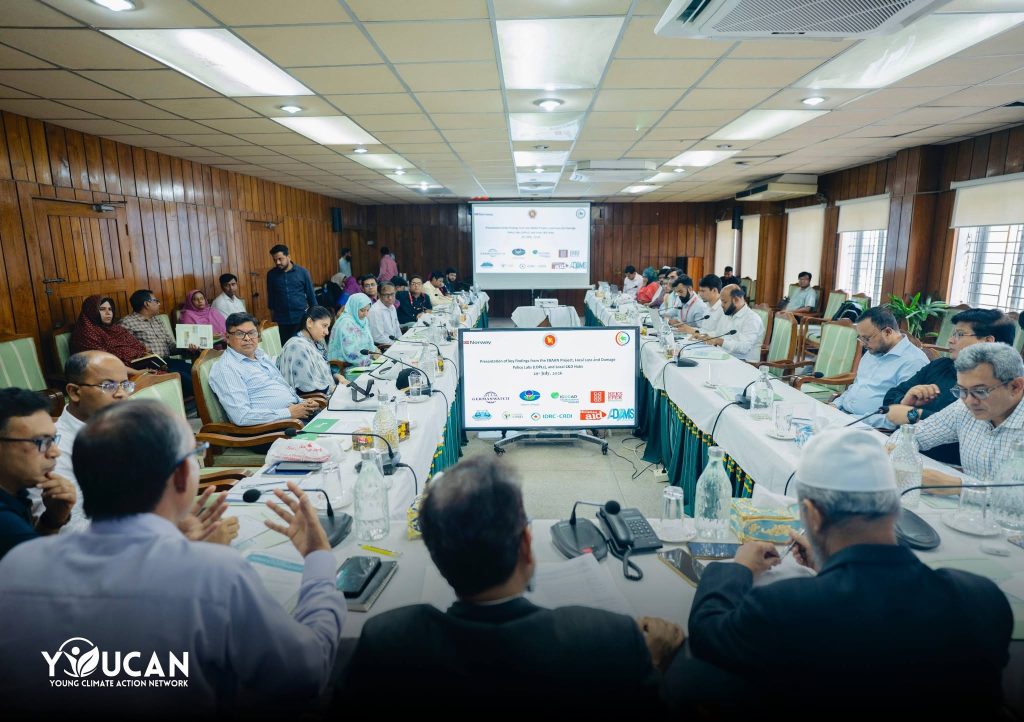
Executive Director Yudhishtir Chandra Biswas and Deputy Executive Director Rashed Jia Rana Engage in Discussions on Integrating Community-Level Evidence into National Climate Policy
Young Climate Action Network (YOUCAN) continues to strengthen its engagement in climate policy and climate justice as its Executive Director, Yudhishtir Chandra Biswas, and Deputy Executive Director, Rashed Jia Rana, participated in a policy dialogue titled “Integrating Non-Economic Loss and Damage (NELD) Evidence into Bangladesh’s National Policy.” The dialogue was held at the Bangladesh Climate Change Trust (BCCT) and brought together stakeholders working to strengthen Bangladesh’s response to climate-related loss and damage.
The dialogue was hosted and convened by BCCT, co-organised by the International Centre for Climate Change and Development (ICCCAD) and ADAMS Foundation, with support from the Royal Norwegian Embassy in Bangladesh.
The discussion focused on how community-level evidence of Non-Economic Loss and Damage can inform Bangladesh’s evolving national policy frameworks, particularly the National Framework and National Mechanism on Loss and Damage (NFLD/NMLD). The participation of YOUCAN’s leadership reflects the importance of youth engagement and civil society perspectives in shaping climate policies that respond to the experiences and needs of climate-affected communities.
Understanding Non-Economic Loss and Damage
Climate change affects communities in ways that extend beyond measurable economic losses. While damaged infrastructure, lost income, and destroyed property are often easier to quantify, climate-related impacts can also affect cultural heritage, social relationships, community identity, mental well-being, traditional knowledge, and people’s connection to their homes and landscapes.
These impacts are commonly discussed under the concept of Non-Economic Loss and Damage (NELD). They can be particularly significant for communities whose livelihoods, cultural practices, and social structures are closely connected to their local environment.
Recognising these losses is essential to developing a more comprehensive understanding of the human consequences of climate change. When non-economic impacts are overlooked, climate assessments and policy responses may fail to capture the full extent of the challenges faced by affected communities.
Integrating NELD evidence into national policy can help ensure that climate responses recognise not only financial and physical damage but also the broader social, cultural, and human dimensions of climate vulnerability.
Bringing Community-Level Evidence into National Policy
One of the central themes of the dialogue was the importance of using evidence from affected communities to inform national approaches to Loss and Damage.
Community-level evidence can help explain how climate-related impacts are experienced in everyday life, which groups face particular challenges, and what kinds of support communities consider meaningful. It can also help policymakers better understand losses that may not be adequately represented through conventional economic assessments.
However, gathering and integrating such evidence requires approaches that are inclusive, context-sensitive, and attentive to the voices of affected people. Community experiences must be documented and interpreted responsibly so that policy decisions reflect local realities rather than relying solely on broad assessments.
The dialogue provided a platform for government representatives, researchers, civil society organisations, and development partners to discuss how this evidence could contribute to the development of Bangladesh’s National Framework and National Mechanism on Loss and Damage.
Strengthening Bangladesh’s National Loss and Damage Framework
Bangladesh is highly exposed to climate-related risks, and many communities face recurring environmental pressures that affect their livelihoods, social well-being, and long-term resilience. Developing effective responses requires policy frameworks that can recognise the diverse impacts of climate change and respond to the needs of affected populations.
The National Framework and National Mechanism on Loss and Damage (NFLD/NMLD) are important to discussions about how Bangladesh can approach Loss and Damage at the national level.
Integrating evidence of non-economic impacts into these processes can help broaden the understanding of climate-related losses and support more inclusive policy development. It can also encourage greater attention to community experiences, locally identified priorities, and the different ways climate change affects people and places.
Continued engagement among government institutions, research organisations, civil society, and development partners is important for strengthening the evidence base and ensuring that policy development remains connected to the realities of climate-affected communities.
Why Youth and Civil Society Participation Matters
Young people and civil society organisations have an important role in climate policy discussions because they can help bring community concerns, emerging priorities, and grassroots experiences into decision-making spaces.
For youth-led organisations such as YOUCAN, meaningful participation involves more than raising awareness about climate change. It also means engaging with policy processes, contributing perspectives from community-level work, and supporting approaches that recognise the needs and rights of people affected by climate impacts.
The participation of Yudhishtir Chandra Biswas and Rashed Jia Rana in the policy dialogue reflects YOUCAN’s continued engagement with national conversations on climate justice and Loss and Damage.
Youth participation is especially important because the decisions made today will influence the environmental, social, and economic conditions experienced by future generations. Creating meaningful opportunities for young people to contribute to policy discussions can help make these processes more inclusive and responsive.
Advancing a More Inclusive and Just Approach to Loss and Damage
Addressing Loss and Damage requires recognising the full range of climate-related impacts and ensuring that the experiences of affected communities inform the policies and mechanisms designed to support them.
Integrating Non-Economic Loss and Damage evidence into national policy is an important part of this effort. It can help draw attention to losses that are difficult to measure financially but remain deeply significant to individuals, families, and communities.
For YOUCAN, this dialogue reinforces the importance of connecting community realities with national climate policy and ensuring that youth and civil society voices contribute meaningfully to climate decision-making.
As Bangladesh continues to develop its approach to Loss and Damage, YOUCAN remains committed to supporting youth engagement, strengthening climate advocacy, and promoting inclusive, evidence-informed responses that recognise the wider human impacts of climate change.
YOUCAN believes that climate justice requires recognising every dimension of climate-related loss, listening to affected communities, and ensuring that their experiences help shape national policies and responses. By strengthening the connection between grassroots evidence and policy action, we can work towards a more inclusive, equitable, and climate-resilient future for Bangladesh.
For more : https://www.facebook.com/share/1DgSuT4My1/