
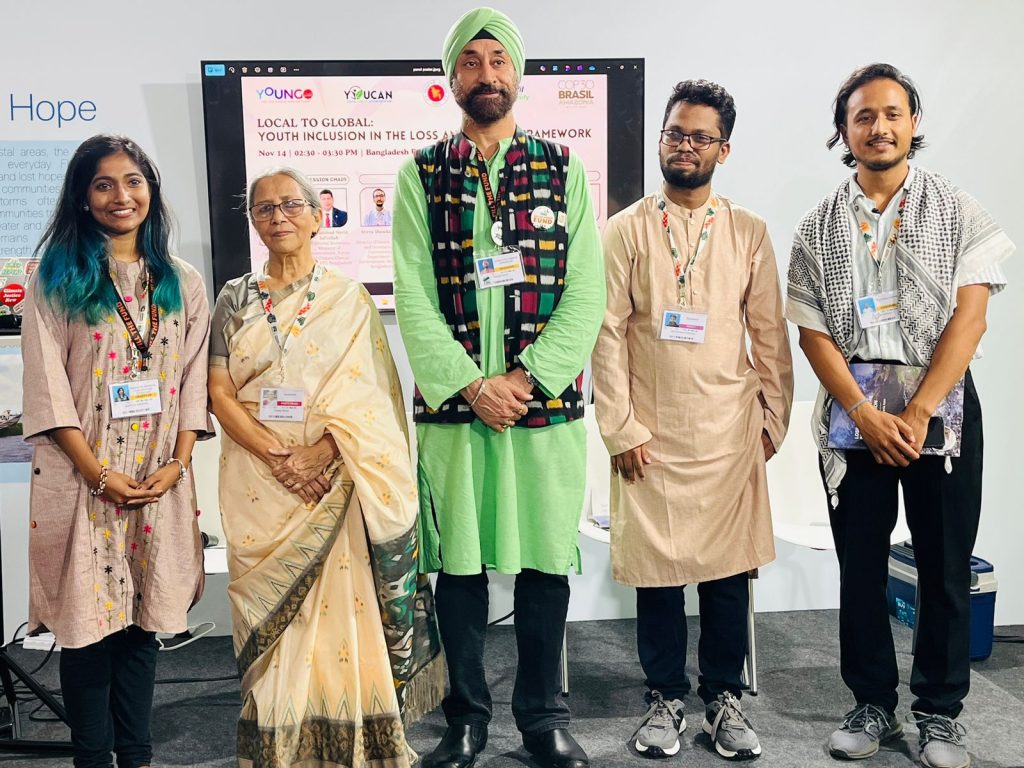
Bangladesh put a sharp spotlight on the growing leadership of young people in steering the finance and policy agenda on Loss and Damage. At a high-level COP30 side event on Friday (14 November) at the Bangladesh Pavilion, youth delegates brought local realities and global demands into one conversation—making it clear that their role is no longer symbolic, but structural.
The session, titled “Local to Global: Youth Inclusion in the Loss and Damage Framework,” was organized by Young Climate Action Network (YOUCAN) and YOUNGO.
Speaking as chief guest, Fisheries and Livestock Adviser Farida Akhter said any Loss and Damage framework would fail unless it centred the communities hit first and hardest. “People on the frontlines must be central to every intervention,” she said.
Mirza Shawkat Ali, a director at the Department of Environment, said Bangladesh was preparing its own national Loss and Damage framework aligned with emerging global mechanisms. “Youth will be effectively integrated into this structure,” he said during his keynote.
Representing global civil society, Harjeet Singh said that real shifts in climate finance negotiations happen when frontline communities and youth movements raise pressure with clarity and purpose. He urged young people to carry three C’s with them: Clarity, Consistency, Courage.
Moderator Jasmima Sabatina delivered YOUNGO’s formal views on the FRLD (Fund for Responding to Loss and Damage) report, emphasizing that the fund must be fast, fair, inclusive, anticipatory, and grounded in the real needs of frontline communities.
Youth delegates laid out key demands:
• Accessible and simplified finance pathways
• Real-time transparency tools
• Anticipatory funding
• Small grants for youth-led initiatives
• Capacity building
• Permanent youth representation in governance
• An open-data platform connecting FRLD, Santiago Network, and WIM
Bangladeshi climate activist Sohanur Rahman stressed the urgency of transparency and accountability in the Loss & Damage Fund, along with dedicated youth-friendly financing windows. Nepal’s Prayas Adhikari highlighted grassroots evidence showing how youth leadership directly supports climate justice and resilience.
The Loss and Damage Fund has opened its first call for project proposals with an initial pool of USD 250 million. But experts questioned both the adequacy and accessibility of the fund, describing it as symbolic against the hundreds of billions needed annually by vulnerable countries. Although total pledges reached roughly USD 700 million in 2023–24, only around USD 397 million is currently held by the fund.
Bangladeshi experts urged rapid capacity-building within the six-month application window and called for coordination among government agencies, research institutions, civil society and development partners to craft competitive proposals. Singh noted that even as COP30 continued, countries such as Jamaica and the Philippines were being hit by climate emergencies: “They need the money now.”
Brazil, the host country, has described the Loss and Damage Fund as one of the fastest-operationalised global funds ever created, arguing that it represents not only financial support but also political recognition of climate justice. Initial disbursements may begin by July next year, though experts warned that complex administrative requirements could pose hurdles for Small Island Developing States and low-income nations.
Representing the Least Developed Countries, Farida Akhter said the crisis demanded urgent, justice-driven action. “Our people’s homes, lives and futures are being altered every day by the climate crisis,” she said. “For us, climate finance is not a bargaining chip it is a matter of survival, justice and dignity. We are here not to restate our suffering, but to pursue solutions equal to the scale of our loss.”
YOUCAN’s presence at the Bangladesh Pavilion sent a clear message: when frontline experience intersects with global diplomacy, policy begins to shift. By consistently bringing youth voices from the ground to the core of global climate architecture, YOUCAN is helping shape a Loss & Damage system that is fair, community-centered, and future-ready.
News: The Climate Watch