
Bangladesh is the world’s ninth most climate-vulnerable nation despite contributing less than 0.3% of global emissions. Over 56% of its population lives in high climate exposure zones, and nearly 700,000 people are displaced by climate-related disasters every year. Groundwater in Dhaka is falling 2–3 metres annually, salinity now contaminates drinking water across the southwestern coastal belt, and in December 2025 the government formally declared 25 subdistricts of the Barind Tract water-crisis zones, a signal that the country’s water security crisis has moved from projection to policy emergency.
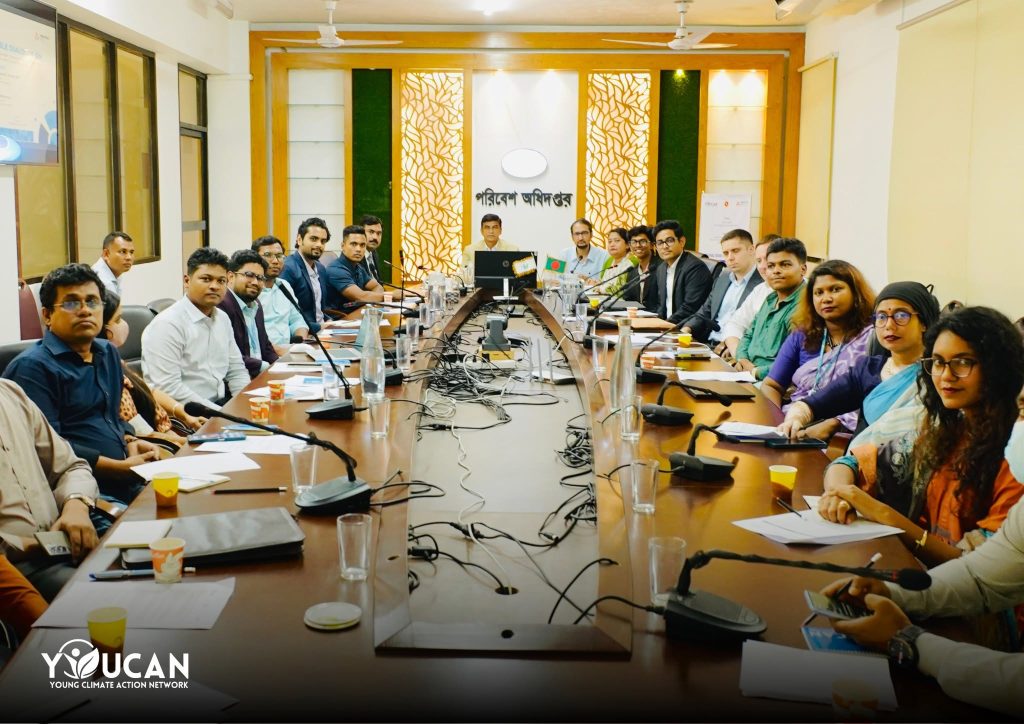
It is against this backdrop that the Young Climate Action Network (YOUCAN) convened the National Roundtable Dialogue on Climate Resilience, Water Security and Sustainable Development in Bangladesh: Policy Priorities, Climate Finance and Future Roadmap, held at the Department of Environment (DoE), Agargaon, Dhaka, in collaboration with the Department of Environment, supported by the Ministry of Water Resources, and in partnership with NIRAPAD Alliance.
Why This Moment Matters
Bangladesh has no shortage of climate policy architecture, the Bangladesh Climate Change Strategy and Action Plan (2009), the National Adaptation Plan (2023–2050), the Bangladesh Delta Plan 2100, and its newly submitted third Nationally Determined Contribution (NDC 3.0, September 2025), which commits to a 20.31% emissions reduction from business-as-usual levels by 2035. What it lacks is consistent execution: coordination deficits across ministries, climate finance that struggles to reach frontline communities, weak monitoring systems, and fragmented programming.
The roundtable convened at a pivotal juncture for closing that gap. Following the formation of a new government in February 2026, Bangladesh entered a new policy and fiscal cycle, anchored by the FY2026–27 national budget of Tk 9.38 trillion the largest in the country’s history and an Annual Development Programme of Tk 3,00,000 crore. Meeting the commitments in NDC 3.0 and the country’s forthcoming National Climate Finance Strategy will require an estimated USD 25.95 billion in unconditional domestic financing and USD 90.23 billion in conditional international support a scale of investment made more urgent by Bangladesh’s approaching graduation from Least Developed Country (LDC) status, which will reshape its access to concessional climate finance.
Bringing the Right Voices to the Table
The dialogue was moderated by Yudhishtir Chandra Biswas, Founder and Executive Director of YOUCAN, with welcome remarks from Fatin Sadaf Lian, Co-Founder of NIRAPAD Alliance, and a keynote address from Barrister Tahmidur Rahman. Mirza Shawkat Ali, Director (Climate Change & International Convention) at the Department of Environment, chaired the session, and Rashed Jia Rana, Deputy Executive Director of YOUCAN, delivered the closing remarks.
Participants included representatives from government ministries and agencies, high commissions, UN agencies, development partners, academia, civil society organizations, media, researchers, and youth leaders a deliberately broad coalition reflecting YOUCAN’s belief that durable climate governance requires government, technical expertise, and community and youth voice at the same table.
The event was honoured by the presence of Hon’ble Mr. Forhad Hossain Azad MP, State Minister, Ministry of Water Resources, as Chief Guest. He reaffirmed the government’s commitment to river restoration, canal re-excavation, safe drinking water access, and climate-resilient water resource management, and announced that work on the long-awaited Teesta Master Plan will begin soon, alongside updates on the Padma Barrage and other Teesta initiatives.
What Was Discussed
Dialogue was structured around six interconnected thematic clusters: climate risk dynamics across Bangladesh’s coastal, riverine, haor, urban, and dryland zones; water security and groundwater governance; implementation bottlenecks in climate finance absorption and inter-ministerial coordination; disaster risk reduction and anticipatory, forecast-based financing; climate justice, gender equality, and local governance; and alignment between national frameworks, the national budget, the SDGs, and the Sendai Framework.
Across these sessions, participants converged on a consistent set of priorities: stronger policy coherence across ministries, expanded and better-targeted climate finance, improved coordination among government, development partners, and civil society, and faster implementation of adaptation measures for the communities already living with these risks.
Expected Outcomes and What Comes Next
The roundtable is expected to produce a Policy Consensus Statement on climate resilience and water security, along with practical recommendations for improving delivery effectiveness and a roadmap for stronger anticipatory, risk-informed systems. YOUCAN and NIRAPAD Alliance are committed to disseminating these outcomes and following up with the stakeholders in the room to keep the momentum moving from dialogue into action.
Why YOUCAN Is Convening This Work
YOUCAN is a youth-led platform working to position young people as essential partners not just beneficiaries in shaping Bangladesh’s climate policy and implementation. Convening a national-level policy dialogue of this scale reflects YOUCAN’s broader mandate: to make sure that as Bangladesh moves from climate commitments to climate finance to climate action, youth voices and evidence from the ground are part of that process from the start.
We are grateful to our partners at the Department of Environment, the Ministry of Water Resources, and NIRAPAD Alliance, and to every guest, speaker, participant, and volunteer who made this dialogue possible. For partners and supporters interested in the follow-up work including the Policy Consensus Statement and continued engagement with government on climate finance and implementation, we welcome the conversation.