
Bangladesh’s Youth and Civil Society Voices in the Global Climate Diplomacy Conversation
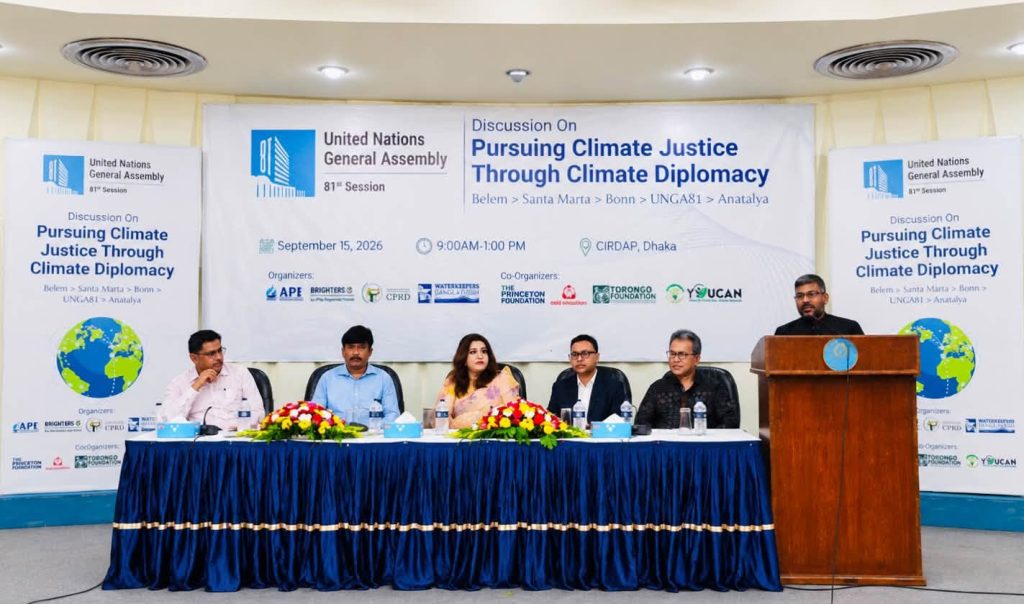
As the global climate conversation continues to evolve, the need for stronger international cooperation, meaningful participation, and justice-centred approaches to climate action has become increasingly important. Against this backdrop, the dialogue “Bangladesh & Climate Diplomacy: From UNGA81 to a Legally Binding Just Transition Treaty” brought together policymakers, government representatives, civil society leaders, climate advocates, youth representatives, and other stakeholders to discuss the future of climate diplomacy and the pathways toward a just and inclusive global transition.
The dialogue created a platform to examine how Bangladesh can strengthen its engagement in international climate diplomacy while ensuring that the concerns and priorities of climate-vulnerable communities remain central to global decision-making. Discussions also focused on the need to move beyond roadmaps and voluntary commitments and explore stronger frameworks that can support a fair, accountable, and people-centred transition.
With climate diplomacy connecting conversations across regions and international platforms—from Belém to Santa Marta, Bonn to New York—the dialogue reflected the increasingly interconnected nature of climate negotiations, development priorities, energy transitions, and global justice.
Bringing Diverse Voices to the Table
The event was honoured by the presence of Ms. Shama Obaed Islam MP, State Minister, Ministry of Foreign Affair, as the Chief Guest. The participation of government representatives, policymakers, civil society actors, climate leaders, and youth voices provided an opportunity for diverse perspectives to come together and contribute to the broader conversation on Bangladesh’s role in global climate diplomacy.
The dialogue emphasized the importance of strengthening collaboration among government institutions, civil society, youth networks, and other stakeholders to ensure that Bangladesh’s climate diplomacy remains responsive to the realities of communities on the frontlines of climate change.
Putting Justice at the Centre of Climate Diplomacy
Yudhishtir Chandra Biswas, Founder & Executive Director of Young Climate Action Network (YOUCAN), delivered guest remarks during the dialogue. He highlighted the importance of ensuring that climate justice, meaningful youth participation, and the voices of climate-vulnerable communities remain at the heart of global climate diplomacy.
His remarks underscored the role of young people not only as participants in climate discussions but also as important stakeholders in shaping the policies, institutions, and international frameworks that will define the future of climate action.
The discussion further highlighted the need for climate diplomacy to address the social and economic dimensions of the transition, ensuring that communities affected by climate change are meaningfully represented in policy processes and that transition pathways are designed around equity, accessibility, and accountability.
From Commitments to Meaningful Action
A key theme emerging from the dialogue was the importance of translating international climate commitments into meaningful action. While roadmaps, pledges, and voluntary commitments remain important components of international cooperation, participants reflected on the need for stronger mechanisms that can ensure implementation, accountability, and equitable outcomes.
The concept of a legally binding Just Transition Treaty was discussed within this broader context, highlighting the importance of international frameworks that recognize the differing responsibilities, capacities, and vulnerabilities of countries and communities.
For Bangladesh, one of the countries highly exposed to the impacts of climate change, meaningful participation in international climate diplomacy is particularly significant. Ensuring that national priorities, community realities, and the concerns of vulnerable populations are reflected in global processes remains an important part of advancing climate justice.
Strengthening Youth-Led Climate Diplomacy
Youth participation was an important dimension of the dialogue. Young people are increasingly engaging in international climate processes, advocacy, research, policy discussions, and community-level action. Their participation brings perspectives that can help connect global policy discussions with the experiences and aspirations of future generations.
Through its participation in the dialogue, YOUCAN reaffirmed its commitment to strengthening youth engagement in climate governance and creating opportunities for young people to contribute meaningfully to national and international climate conversations.
YOUCAN co-organized the dialogue alongside its organizing partners, contributing to a growing youth-led movement working toward a just, inclusive, and people-centred climate transition.
Looking Ahead
The dialogue served as an important space for reflection, exchange, and collaboration among diverse stakeholders working across climate action and diplomacy. It reinforced the importance of continued dialogue between policymakers, civil society, youth, and climate-vulnerable communities in shaping more inclusive approaches to global climate governance.
As the international climate agenda continues to develop, Bangladesh’s experience and the voices of its young people and vulnerable communities can contribute valuable perspectives to the global discussion on justice, responsibility, resilience, and a fair transition.
The conversation from UNGA81 to a legally binding Just Transition Treaty is ultimately a conversation about how global climate commitments can translate into meaningful, equitable, and lasting outcomes for people and communitiy YOUCAN remains committed to advancing youth-led climate action, strengthening climate diplomacy, and supporting a transition that places justice, inclusion, and the voices of climate-vulnerable communities at its centr
About more : https://www.facebook.com/share/p/1GzeW57XmG/