I. The Genesis of a Movement
For decades, political manifestos in Bangladesh shared a common trait: environmental issues were “tokenized.” In the 2018 and even the early 2024 drafts, major political parties dedicated less than 1% of their platforms to climate change, often limited to a single sentence about general reforestation.
Against this backdrop, the ‘Road to Green Manifesto’ was born. Led by a coalition of more than 14 organizations including Shocheton Foundation, Young Climate Action Network-YOUCAN, Waterkeepers Bangladesh, Climate Frontier, Brighters, CAPS, OAB Foundation, YEDO, C3ER, ESN, CPRD, O.CREEDS, Dhaka North City Corporation, and NACOM, they embarked on a seven-month mission to move climate change from the footnotes of politics to the center of the national agenda.
II. The Catalyst: Multi-Stakeholder Political Integration
The initiative’s impact was solidified through high-level consultations involving over 300 participants. Youth activists and environmental experts challenged senior decision-makers from both the BNP and Bangladesh Jamaat-e-Islami to integrate rural resilience and “salinity justice” into their core visions.
Key participants included:
-
BNP: Amir Khasru Mahmud Chowdhury (standing committee member of Bangladesh Nationalist Party, Abdul Awal Mintu, and Mahdi Amin.
-
Jamaat-e-Islami: Ehsanul Mahbub Zubair (Assistant Secretary General), Dr. Rezaul Karim and other senior representatives.
These dialogues served as a policy incubator where the coalition presented a Youth Policy Brief addressing the vulnerabilities of coastal farmers, green jobs, and water security.
III. The Evidence: A Historic Transformation
The most tangible proof of impact is the evolution of the major political manifestos from “symbolic mentions” to “actionable roadmaps.”
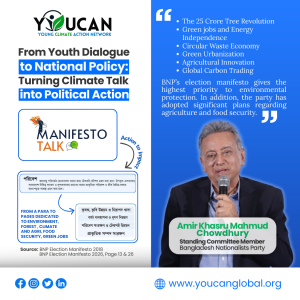
1. Bangladesh Nationalist Party (BNP): From One-Line to Full-Page
By tracking the party’s language before and after the “Road to Green” sessions, the data reveals a historic pivot.
| The “Before” Era (2018) | The “Road to Green” Era (2026) |
| Tokenized: A singular mention of “Climate Changes” as a sub-point with no actionable roadmap. | Ecological Revolution: A large-scale ecological plan responding directly to youth advocacy. |
Key BNP Commitments:
-
50 Crore Sapling Revolution: A massive pledge to increase forest cover across the country.
-
20,000 km Canal Excavation: Strategic commitment to mitigate floods and provide irrigation.
-
“One Child, One Tree”: A flagship program to foster environmental leadership from childhood.
-
Green Incentives: A 30% tax incentive for green entrepreneurs and pollution-based taxation.
-
Water Justice: A “Bangladesh First” foreign policy to secure fair water shares from 54 transboundary rivers.
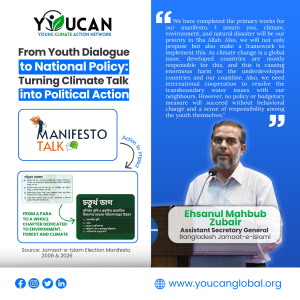
2. Bangladesh Jamaat-e-Islami: The “Three Zero Vision”
Following the active participation of leaders like Ehsanul Mahbub Zubair, Jamaat-e-Islami underwent its most significant environmental policy shift in party history.
| The “Before” Era (Previous) | The “Road to Green” Era (2026) |
| Traditional: Focused on religious social welfare and general agricultural aid. | Scientific Stewardship: Environment and Climate Change now sit as a top Priority Area. |
Key Jamaat-e-Islami Commitments
-
The “Three Zero Vision”: A formal pledge to achieve Zero Environmental Degradation, Zero Waste, and Zero Flood Risk.
-
Buriganga & River Protection: Specific plans to free the Buriganga and other rivers from illegal encroachment and pollution to revive tourism and local economies.
-
Green Textile Tax Credit: Proposing a 30% incentive for export-oriented entrepreneurs committed to sustainable practices.
-
Technology-Driven Agriculture: Shifting to a modernization model that includes salinity-resilient farming and advanced irrigation.
-
Urban Livability: Massive investments in sewerage failure correction and modern waste management to ensure “Clean & Green” cities.
IV. Why This Matters
This outcome proves three critical points:
-
Youth Engagement Works: When structured and persistent, youth are agenda-setters, not just stakeholders.
-
Cross-Partisan Consensus: Climate justice has moved beyond party lines, with both the BNP and Jamaat-led alliances adopting the coalition’s core demands.
-
Policy Over Confrontation: Meaningful change can enter mainstream politics through rigorous dialogue and evidence-based advocacy.
V. Conclusion: From Advocacy to Accountability
While the “Road to Green” was a collective effort, Young Climate Action Network-YOUCAN served as the Data & Advocacy Engine of the movement. Our role focused on turning the lived realities of 180 million citizens into a language that political leaders could not ignore.
YOUCAN spearheaded a nationwide survey of 500+ youth leaders across all 64 districts. This data provided the “Road to Green” coalition with the empirical proof needed to show political parties that climate change is a top-three priority for the Gen-Z electorate.
We translated complex environmental science into the Youth Demand Charter. This document was the primary tool used in negotiations to secure:
-
The BNP’s “One Child, One Tree” initiative.
-
Jamaat-e-Islami’s “Three Zero Vision” (Zero Waste, Zero Degradation, Zero Flood Risk).
YOUCAN facilitated direct accountability sessions between youth delegates and top-tier leadership, including Amir Khasru Mahmud Chowdhury (BNP) and Ehsanul Mahbub Zubair (Jamaat-e-Islami). We moved the needle from “polite discussion” to “documented manifesto commitment.”
The 13th National Parliament Election on February 12, 2026, represents a transition, not a conclusion. The “Road to Green” coalition is now pivoting toward a Governance Oversight Role.
Our focus has shifted from inclusion in manifestos to the implementation of “Green Laws.” Our objective remains clear: ensuring that these historic political promises are converted into measurable climate action and sustainable legislative frameworks.
Sources and Data References
Political Manifestos:
Bangladesh Nationalist Party (BNP) Election Manifesto 2026, published February 6, 2026.
BNP 2018 Election Manifesto: ‘Vision 2030’ Review.
Bangladesh Jamaat-e-Islami Election Manifesto 2008, published Dec 2008.
Bangladesh Jamaat-e-Islami Election Manifesto 2026
News_Coverage_List_Manifesto_Talk_01.06.2025
Manifesto Talk Official Facebook Page
Manifesto Talk 3; Fossil Fuels to Renewable Energy and Just Transition