
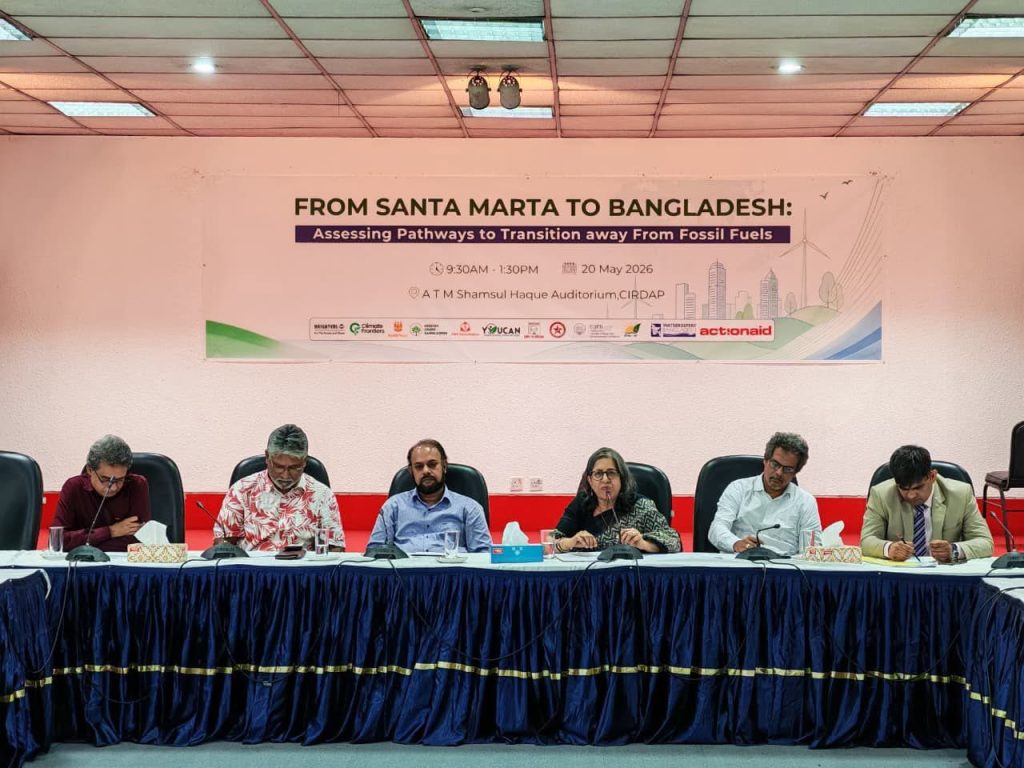
“From Santa Marta to Bangladesh” Dialogue Calls for Renewable Energy Investment, Climate Finance, and an Inclusive Just Energy Transition Ahead of COP31
Young Climate Action Network (YOUCAN) joined Waterkeepers Bangladesh and 10 like-minded organisations in convening a significant national dialogue in Dhaka titled “From Santa Marta to Bangladesh: Assessing Pathways to Transitioning Away from Fossil Fuels.”
The dialogue brought together policymakers, researchers, climate advocates, youth leaders, farmers’ representatives, and civil society actors to examine practical pathways for Bangladesh to move away from fossil fuels towards a more sustainable, renewable energy-based future.
The session was chaired by Farah Kabir, Country Director of ActionAid Bangladesh, while Md.Ziaul Haque, Additional Director General of the Department of Environment, Bangladesh, attended as the Chief Guest. Distinguished speakers included Sharif Jamil, Coordinator of Waterkeepers Bangladesh; Shafiqul Alam, Lead Analyst at IEEFA Bangladesh; and Badrul Alam, President of Bangladesh Krishok Federation, among others.
The discussion underscored the urgency of developing a practical, inclusive, and people-centred roadmap for Bangladesh’s energy transition—one that advances climate justice, strengthens energy sustainability, and supports equitable economic development.
From Global Climate Dialogue to National Action
The transition away from fossil fuels has become an important part of global discussions on climate action. For Bangladesh, translating international climate commitments into practical national strategies requires coordinated planning, appropriate financing, supportive policies, and meaningful participation from affected communities.
The dialogue, “From Santa Marta to Bangladesh,” created a platform to consider how broader discussions on moving away from fossil fuels can inform Bangladesh’s national priorities and energy planning.
Participants explored the need to accelerate renewable energy development while addressing the financial, institutional, and social challenges associated with transforming existing energy systems.
A central message emerging from the discussion was that the energy transition must be guided by a clear and practical roadmap. Such a roadmap should recognise Bangladesh’s development priorities while ensuring that long-term energy decisions are consistent with climate resilience, environmental sustainability, and social equity.
The dialogue also highlighted the importance of connecting global climate ambitions with national policy decisions, public investment, and practical implementation.
Accelerating Investment in Renewable Energy
Increasing investment in renewable energy emerged as a key recommendation of the dialogue.
Expanding renewable energy can help Bangladesh diversify its energy mix and reduce dependence on fossil fuels. However, achieving this transition requires a supportive policy environment, access to finance, appropriate infrastructure, and investment strategies that enable renewable energy projects to develop and expand.
Participants emphasised the importance of strengthening investment in renewable energy initiatives and creating more favourable conditions for their implementation.
The discussion also called for dedicated incentives for renewable energy in the upcoming national budget. Such measures were highlighted as an important consideration in encouraging investment and supporting the growth of cleaner energy solutions.
Another recommendation was to withdraw taxes and duties imposed on solar energy equipment. Addressing these cost-related barriers could help improve the affordability and accessibility of solar technologies and support wider adoption.
These proposals reflect the need to align public financial and fiscal policies with Bangladesh’s renewable energy ambitions.
Phasing Out Coal Expansion and Advancing Sustainable Energy Planning
The dialogue highlighted the importance of reassessing the role of fossil fuels in Bangladesh’s long-term energy development.
Among the recommendations was a call to phase out the expansion of coal-based power generation and place renewable energy at the centre of future national development strategies.
Long-term energy planning involves balancing energy security, affordability, economic development, and environmental responsibility. As Bangladesh considers its future energy needs, participants stressed the importance of exploring pathways that reduce reliance on fossil fuels while supporting a more sustainable and climate-resilient economy.
A renewable energy-centred development strategy would require clear policy direction, sustained investment, effective implementation, and coordination among relevant institutions and stakeholders.
The dialogue also emphasised the importance of advancing these priorities ahead of COP31, providing an opportunity for Bangladesh to strengthen its approach to energy transition and demonstrate greater ambition in aligning national development planning with climate objectives.
Climate Finance: A Critical Enabler of a Just Transition
Access to adequate climate finance was another major recommendation from the discussion.
Developing countries face significant financial and technical challenges in transitioning towards low-carbon energy systems while continuing to address development needs and climate-related vulnerabilities.
For Bangladesh, adequate and accessible climate finance can support renewable energy investment, strengthen infrastructure, facilitate technological development, and help communities navigate the social and economic implications of the transition.
The dialogue called for securing adequate climate finance for developing countries, highlighting the importance of international support in enabling a fair and achievable transition away from fossil fuels.
Climate finance is particularly important when national ambitions depend on investments that may exceed available domestic resources. Effective financing arrangements can help bridge these gaps and support the implementation of climate and energy priorities.
The discussion reinforced the need to connect global climate commitments with practical financial mechanisms that enable developing countries to pursue sustainable development while addressing climate change.
Ensuring Meaningful Participation in the Just Transition
A central principle of a just transition is that the shift towards sustainable energy should not leave affected people and communities behind.
The dialogue called for the meaningful participation of women, young people, workers, and local communities in just transition processes.
These groups bring different experiences, priorities, and perspectives to energy-related decisions. Women and local communities may experience the impacts of energy development differently, while workers may face changes in employment and skills requirements as industries evolve. Young people, meanwhile, have a long-term stake in the environmental, economic, and social consequences of decisions made today.
Meaningful participation requires more than representation at meetings. It involves creating opportunities for people to contribute to discussions, share concerns, influence decisions, and participate in shaping policies and programmes that affect their lives.
For YOUCAN, youth engagement is particularly important. Young people should be recognised not only as advocates for climate action but also as active contributors to the planning and implementation of Bangladesh’s energy transition.
An inclusive process can help ensure that the transition responds to community needs, considers different social realities, and distributes its opportunities and challenges more fairly.
Connecting Climate Justice, Agriculture, and Livelihoods
The participation of farmers’ representatives and civil society actors added important perspectives to the national dialogue.
Energy systems and climate policies can have implications beyond the electricity sector. They intersect with livelihoods, economic opportunities, environmental conditions, and the well-being of communities.
A just transition therefore needs to consider how decisions affect people across different sectors and locations. This includes recognising the concerns of workers, farmers, and communities whose livelihoods may be influenced by changing energy systems and climate-related pressures.
Climate justice calls for approaches that acknowledge unequal vulnerabilities and ensure that the benefits of sustainable development are accessible to different groups in society.
By bringing together participants from policy, research, youth movements, agriculture, and civil society, the dialogue provided an opportunity to examine the energy transition through a broader social and economic lens.
Such cross-sector engagement is essential to developing policies that are environmentally responsible while remaining responsive to people’s needs and development priorities.
The Role of YOUCAN in Advancing Just Energy Transition
As a youth-led network working on climate action and environmental justice, YOUCAN recognises that transitioning away from fossil fuels requires more than technological change. It demands sustained advocacy, informed public discussion, supportive policies, adequate financing, and inclusive decision-making.
YOUCAN has been engaged in just energy transition work for the past two years, supporting conversations that connect renewable energy, climate justice, youth leadership, and sustainable development.
Its participation in this national dialogue reflects its continued commitment to contributing to discussions about Bangladesh’s energy future and encouraging meaningful youth participation in climate and energy policymaking.
By engaging with policymakers, researchers, civil society organisations, and community representatives, youth-led networks can help bring emerging generations’ perspectives into national discussions and support broader public understanding of the transition.
YOUCAN believes that the pathway towards a sustainable energy future must be guided by equity, accountability, and the principle that no one should be left behind.
Key Recommendations from the National Dialogue
The discussion highlighted seven key recommendations for advancing Bangladesh’s transition away from fossil fuels:
- Increase investment in renewable energy initiatives to support the expansion of cleaner energy systems.
- Introduce dedicated renewable energy incentives in the upcoming national budget to encourage investment and development.
- Secure adequate climate finance for developing countries to support the financial requirements of the transition.
- Ensure meaningful participation of women, youth, workers, and local communities in just transition processes.
- Withdraw taxes and duties imposed on solar energy equipment to help improve affordability and access.
- Phase out the expansion of coal-based power generation as part of a shift towards more sustainable energy planning.
- Adopt renewable energy-centred national development strategies ahead of COP31 to strengthen Bangladesh’s long-term energy transition pathway.
Together, these recommendations point towards the need for coordinated policy action, stronger investment, international cooperation, and inclusive public participation.
Looking Ahead: A People-Centred Energy Future for Bangladesh
The national dialogue highlighted the importance of moving from broad commitments to practical measures that can accelerate Bangladesh’s transition away from fossil fuels.
Achieving this transformation will require collaboration among government institutions, businesses, researchers, civil society, youth organisations, farmers’ representatives, workers, and local communities. It will also require policies and financial arrangements that support renewable energy development while addressing the social and economic dimensions of the transition.
YOUCAN appreciates Waterkeepers Bangladesh, ActionAid Bangladesh, the other participating organisations, and all speakers and stakeholders who contributed to the dialogue.
The organisation remains committed to supporting youth-led climate advocacy, advancing just energy transition, and encouraging inclusive approaches to sustainable development. Through continued engagement and collaboration, YOUCAN seeks to help strengthen the role of young people in shaping a fairer, cleaner, and more climate-resilient Bangladesh.
The transition away from fossil fuels must be more than an energy-sector shift. It must be a commitment to climate justice, renewable energy, inclusive decision-making, and a sustainable future in which people and communities are not left behind.
YOU CAN CHANGE THE WORLD.
For more : https://www.facebook.com/share/1ZG4qes5mZ/