
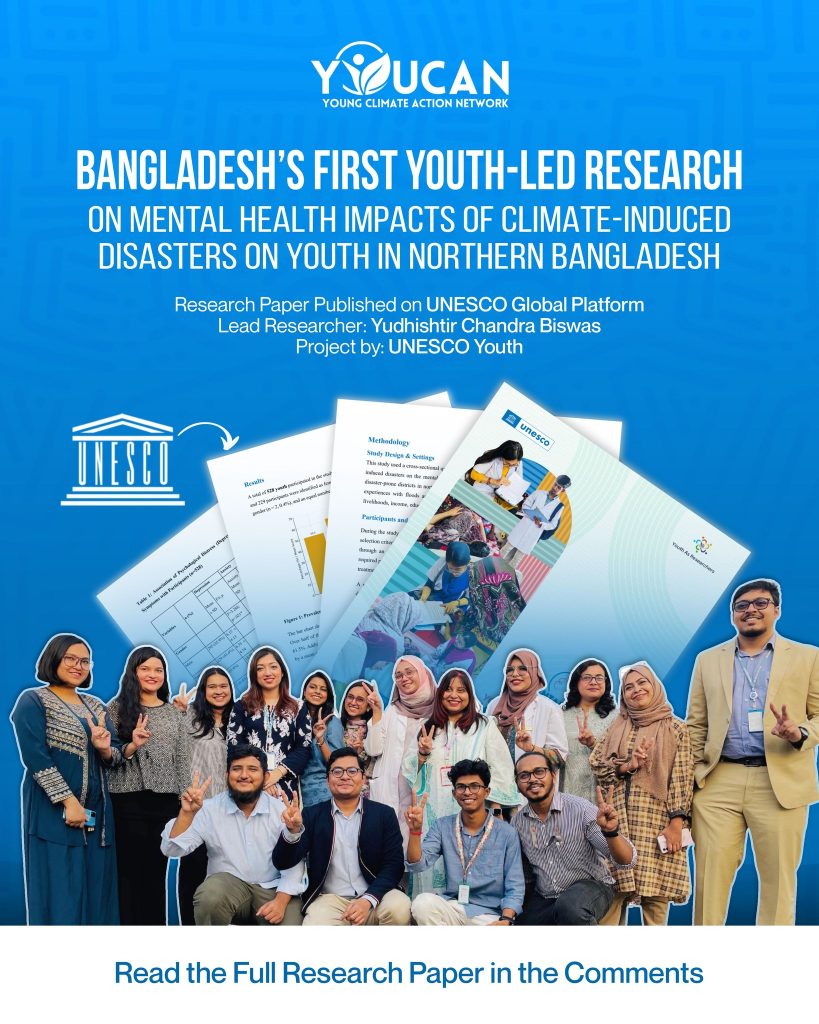
YOUCAN Global has announced a significant milestone in youth-led research, as its Founder, Yudhishtir Chandra Biswas, successfully led and published a United Nations-supported study at the age of 18.
The research was conducted under the Youth As Researchers initiative of UNESCO Youth, with support from UNESCO Dhaka. Serving as Principal Investigator, he led the study titled “Mental Health Impacts of Climate-Induced Disasters on Youth in Northern Bangladesh.”
Context
Bangladesh continues to face recurring climate-induced disasters, particularly in its northern regions, where floods, river erosion, and extreme weather events disrupt livelihoods and stability. While physical and economic losses are widely documented, the psychological impact on young people remains largely ignored in policy and response frameworks.
This research directly addresses that gap by examining how climate vulnerability affects youth mental health, an area that is consistently overlooked despite its long-term consequences on resilience, productivity, and social stability.
Research Scope and Contribution
Conducted between November 2024 and January 2026, the study provides evidence on the intersection of climate change and mental health among youth populations. It moves beyond surface-level discussion and contributes data that can inform policy, programming, and targeted interventions.
The research positions youth not as passive victims but as both subjects and producers of knowledge. That distinction matters. Most studies about youth exclude them from authorship. This one doesn’t.
Research Team
The study was co-authored by a diverse team of young researchers, including Murad Ansary, Sadia Mirza, Asim Nabil, Probin Henry Tripura, and Saila Sobnom Richi.
Significance
This is not just a personal achievement. It signals that youth-led research can produce work relevant to global institutions. At 18, leading a UN-supported study is rare, but the age matters less than the output. If the research influences policy or programming, it has value. If it doesn’t, then it’s just symbolic recognition.
The study contributes to broader conversations on climate justice, mental health, and youth inclusion in research and decision-making spaces. It also challenges the tendency to treat youth as beneficiaries rather than contributors in global development discourse.
Acknowledgement and Way Forward
YOUCAN Global extended its gratitude to UNESCO Dhaka and all members of the research team for their contributions. The next step is obvious: translate findings into policy engagement, advocacy, and implementation. Without that, the research stays on paper and achieves nothing beyond publication.
For More visit : Facebook post