
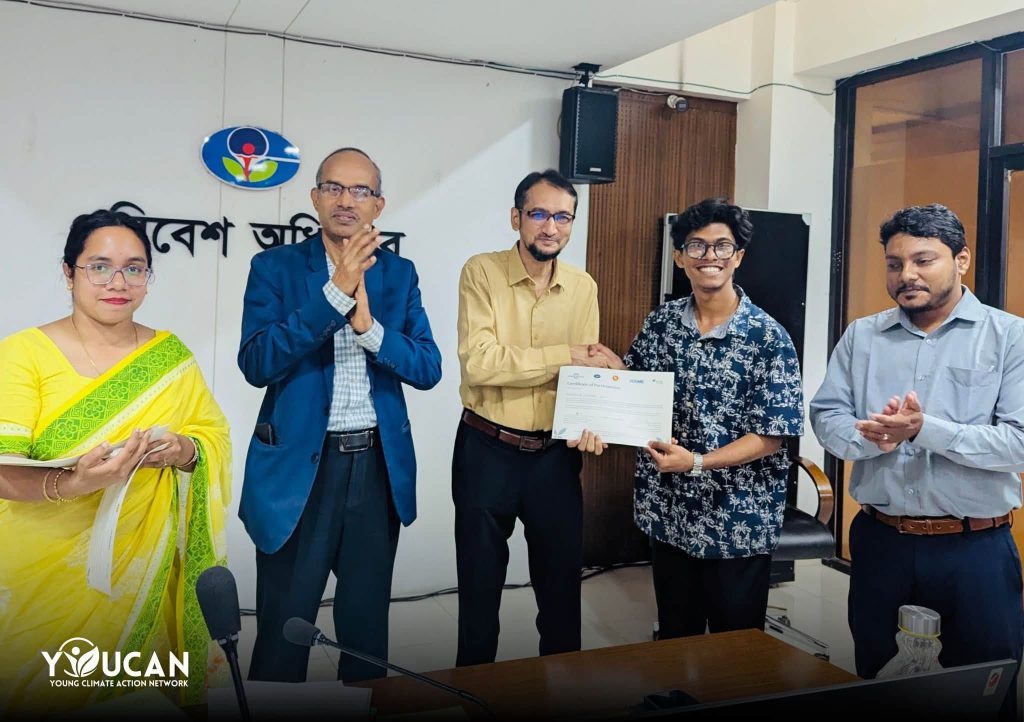
Executive Director Yudhishtir Chandra Biswas Participates in Capacity-Building Workshop on Climate Change Policy and Governance
Young Climate Action Network (YOUCAN Global) continues to strengthen its engagement in climate policy, water security, and climate resilience through the participation of its Executive Director, Yudhishtir Chandra Biswas, in a two-day Capacity Building Workshop on Climate Change Policy and Governance.
The workshop was organised by the International Centre for Climate Change and Development (ICCCAD), the Department of Environment (DoE), Bangladesh, and ADAMS Foundation. It provided an important opportunity to deepen understanding of climate policy and governance, explore key climate-related challenges, and strengthen knowledge of the policy and financing mechanisms needed to support climate-vulnerable communities.
Yudhishtir Chandra Biswas participated in the workshop as part of YOUCAN’s broader commitment to connecting grassroots experiences with national climate policy discussions and advocating for effective, inclusive, and community-centred climate action.
Strengthening Understanding of Climate Policy and Governance
Effective climate action requires more than awareness of environmental challenges. It also depends on strong governance, informed policymaking, institutional coordination, and access to the resources needed to implement solutions.
The capacity-building workshop offered an important platform for strengthening knowledge of climate change policy and governance and examining how policy frameworks can better respond to the realities of climate-vulnerable communities. Such learning opportunities are essential for organisations working to bridge the gap between local needs and broader policy priorities.
For youth-led organisations like YOUCAN, engaging with climate policy and governance helps strengthen advocacy, improve understanding of institutional processes, and support more informed participation in climate-related decision-making.
Water Security and Climate Resilience in Vulnerable Communities
Water security is closely connected to climate resilience, livelihoods, public well-being, and sustainable development. In Bangladesh, haor and coastal areas face distinct environmental challenges that can affect communities’ access to safe and reliable water, livelihoods, and capacity to respond to climate-related risks.
Through its work on water security and climate resilience, YOUCAN seeks to highlight the needs and experiences of communities living in these climate-sensitive regions. Strengthening resilience requires approaches that consider local realities, encourage community participation, and connect practical needs with effective policies and support mechanisms.
The workshop provided a relevant opportunity to strengthen the knowledge needed to engage with these interconnected challenges and reinforce the importance of bringing community perspectives into climate policy discussions.
Advancing Loss and Damage and Climate Finance
Loss and Damage remains a critical issue for communities experiencing climate-related impacts that cannot be fully avoided through mitigation or adaptation alone. These impacts can affect livelihoods, homes, local economies, ecosystems, and the social well-being of vulnerable populations.
Addressing Loss and Damage requires sustained attention to the needs of affected communities, alongside effective policy frameworks, institutional support, and accessible climate finance. Ensuring that support reaches those who need it most is an important consideration in advancing climate justice.
For Bangladesh, where climate-related risks affect communities across different regions, strengthening understanding of Loss and Damage and climate finance is essential to meaningful climate advocacy. These issues are particularly relevant to vulnerable haor and coastal communities, whose needs and experiences must be reflected in discussions about climate responses and support.
By strengthening its engagement with climate policy and governance, YOUCAN aims to contribute to advocacy that connects the lived realities of affected communities with wider discussions on climate finance, resilience, and equitable support.
Connecting Grassroots Realities with Climate Policy
A central priority of YOUCAN’s climate work is ensuring that the experiences and concerns of communities directly affected by climate change inform broader policy discussions. Grassroots perspectives provide important insights into the challenges people face and the support required to strengthen their resilience.
Meaningful climate action depends on stronger connections between communities, civil society organisations, policymakers, and relevant institutions. Capacity building can help strengthen these connections by equipping organisations with the knowledge needed to engage more effectively in policy dialogue and advocacy.
Yudhishtir Chandra Biswas’s participation in the workshop reflects YOUCAN’s continued interest in strengthening this connection and supporting climate action that is informed by local realities and responsive to community needs.
YOUCAN’s Commitment to Inclusive and Community-Centred Climate Action
YOUCAN remains committed to advancing climate justice, strengthening youth-led advocacy, and promoting approaches to climate action that prioritise the needs of vulnerable communities. Its work on water security, climate resilience, and Loss and Damage reflects the importance of addressing both the immediate challenges faced by affected communities and the broader policy and governance issues shaping climate responses.
Through continued learning, collaboration, and engagement with climate policy processes, YOUCAN seeks to strengthen the role of young people and civil society in advancing more inclusive and effective climate solutions.
YOUCAN believes that meaningful climate action begins by listening to affected communities and ensuring that their realities shape the policies and support systems designed to protect them. By connecting grassroots experiences with climate policy and action, YOUCAN continues to work towards a more resilient, equitable, and climate-just future for Bangladesh.
For more : https://www.facebook.com/share/18ne4zRPz8/